

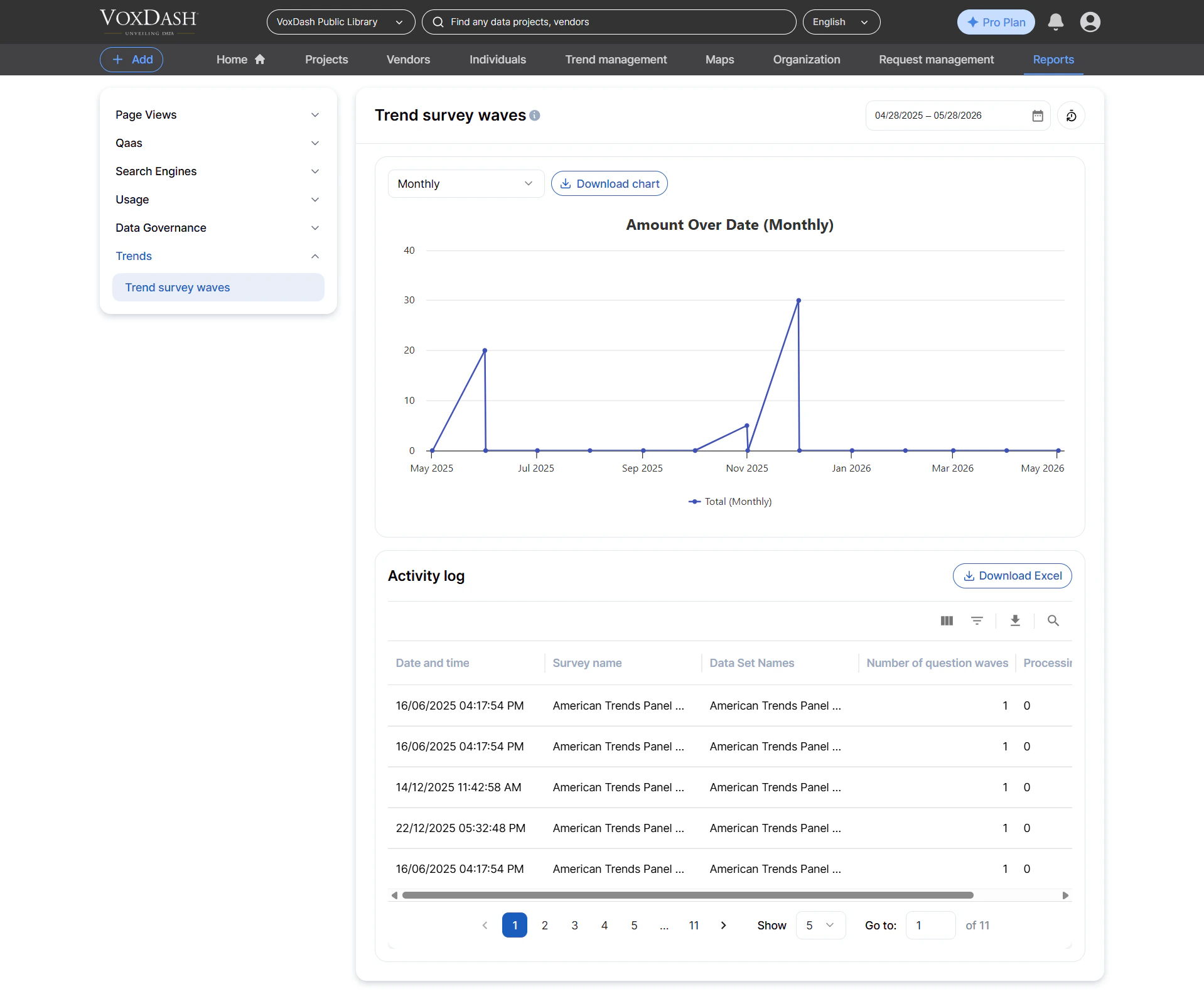
Trend Survey Waves
Lists all trend surveys that have been processed, providing a comprehensive overview of your longitudinal data collection efforts. Information included:- Survey name
- Associated dataset name(s)
- Number of question waves (i.e., how many distinct points in time this survey has been tracked)
- Total processing time for all waves (e.g., in hours or minutes)
- Creation date of the survey wave
- Monitoring the progress and history of your trend surveys
- Assessing the scope and depth of your time-series data
- Identifying surveys that require more or less processing time, which can indicate complexity or efficiency issues
Trend Processing Time
Returns the total processing time (aggregated across all completed trend analyses) spent computing trend analyses. Information included:- Total time, usually expressed in hours.
- Helps in estimating computational resources used for trend analysis
- Can be used to identify performance bottlenecks or highly resource‑intensive trend calculations
- Useful for capacity planning and cost allocation
Unique Trended Questions
Returns the total count of unique questions that are part of any trend analysis wave. This metric helps differentiate between a question appearing multiple times across waves and a distinct question being tracked. Information included:- A single number representing the count of distinct questions.
- Measures the breadth of topics covered by trend analysis, rather than just the frequency of appearance
- Provides a clearer picture of the diversity of data points being monitored over time
- Essential for understanding the true scope of longitudinal insights